A standard garage door installation in Lincoln Park and the Downriver suburbs means stripping out the old door and hardware, squaring and reinforcing an older opening if the header needs it, mounting and insulating a door sized for a Michigan winter, and finishing with a working opener, typically inside a single day on a straightforward job. This guide walks through what actually drives the cost, how the timeline really breaks down, how to think about insulation, what to check on permits before you book, and how to tell a repair from a real replacement.
TL;DR
- A standard installation removes the old door and hardware, checks the opening is square, mounts new tracks and springs, and sets the opener, usually in one visit.
- Older Downriver homes can need framing repair before the new door goes in, which is a real but not universal pattern.
- Door material and opener brand are their own decisions, each with a dedicated comparison guide.
- National installed cost ranges run about $600 to $2,500 for steel doors and higher for insulated, custom, or wood, and your actual price depends on your home.
Lincoln Park sits in the middle of the Downriver corridor, alongside Wyandotte, Southgate, Taylor, River Rouge, and Melvindale, and a lot of the garages I work on down there were not built with a modern door in mind. That is not a knock on the neighborhood. It is just what happens when a city grows up fast around a manufacturing base and most of the housing stock predates the current sizing standards a door manufacturer builds to today. This guide is the decision-making piece: what the job actually involves, what moves the price up or down, how long it really takes, how to pick insulation for a Downriver winter, what to check on permits before you book anything, and when a problem is a repair instead of a full replacement. If you already know you want a quote for your specific address, our Lincoln Park service page is the faster path. This post is for working through the decision first.
What Actually Happens During a Garage Door Installation on a Downriver Home
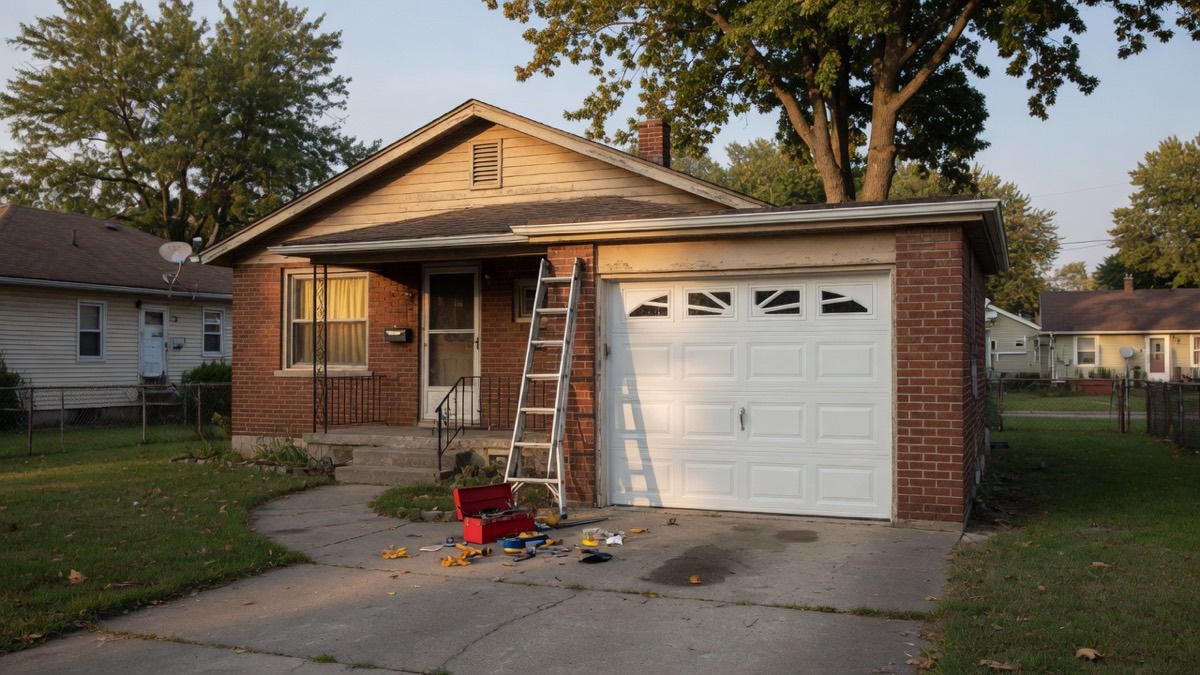
A standard installation means stripping out the old door's fasteners, tracks, and hardware, confirming the opening is level, plumb, and square, and checking that the header beam can carry the new door's weight without sagging or cracking. The crew then mounts new tracks, sets the door sections, tensions the springs, and installs and programs the opener if one is included.
I check the header first, every time, before a single new track goes up. That beam is what carries the door's weight and the spring tension both, and on an older Downriver home it has usually never been inspected since the house was built. If it is sound, the rest of the job is mechanical: track, panels, springs, opener, done. Door material is its own decision inside this process, and we have a full breakdown of what holds up in a Michigan driveway in our garage door brand comparison for Detroit's climate. Opener brand is the other sub-decision that comes up on nearly every install, and we cover the two most common choices head to head in our LiftMaster vs. Chamberlain comparison. Both of those are worth reading before your install date, not after, since the opener and the door get selected together. For the base service itself, see our residential installation page.
Older Housing, Non-Standard Openings: What Downriver's Older Stock Can Add to the Job
Lincoln Park was incorporated as a city in 1925 and grew as a bedroom community for auto industry workers, so Downriver carries a lot of early to mid twentieth century housing stock. On an older home, an installer's job can include finding a header or framing that has sagged, cracked, or was never sized for a modern door, and addressing it before the new door goes in, not after.
I want to be careful here, because this is a real pattern, not a guarantee. Not every older Downriver garage has a problem. But when a header has sagged or shifted over decades, you find out the moment you pull the old hardware, and the honest move is to fix that framing before a single new track goes up, not after the door is already hung. A door mounted on an out of square opening will bind, wear its rollers early, and fight the opener every single cycle. That is a callback waiting to happen, and it is entirely preventable at the framing stage.
1925
Year Lincoln Park was incorporated as a city
$600 to $2,500
National installed cost range for steel doors
Choosing the Right Door Material for a Michigan Driveway
Steel, insulated steel, and wood or composite doors all perform differently in a Michigan driveway, and the right pick depends on your budget, how the garage connects to the house, and how much upkeep you want to take on. Rather than re-deriving those tradeoffs here, we point you to our dedicated garage door brand comparison for Detroit's climate, which walks through the material and brand tradeoffs in full.
The short version, before you click over: steel is the workhorse choice for most Downriver homes, low maintenance and available in a range of insulation levels. Wood and composite doors look better on an older brick or clapboard home but need real upkeep against Michigan's freeze thaw cycle. Which one is right for your house is really a function of your garage's role, straight parking versus an attached space that shares a wall with living space, which we get into next.
What Actually Drives Your Installation Quote Up or Down
National cost aggregators put a single-car steel door around $600 to $1,500 installed and a double-car steel door around $1,000 to $2,500, with insulated, custom, or wood doors running higher. Those are national ranges, not a 313 Garage Door quote, and Metro Detroit pricing can differ. Before we get to a line-item breakdown, it helps to know what actually moves a quote within those ranges.
Four things move the number most: door size (single-car versus double-car), material and insulation level, whether the opening is standard or needs custom sizing, and whether the old track and door need to be removed and hauled away. We wrote a full pricing breakdown for repair costs specifically in our Detroit repair cost guide, which uses the same "your actual number depends on your home" framing we are using here for installation.
$600 to $1,500
Single-car steel, installed (national)
$1,000 to $2,500
Double-car steel, installed (national)
4
Factors that move your price most
Door Size, Material, and Insulation: The Line Items That Move Your Price the Most
The table below lays out installed cost ranges by door type: single-car steel, double-car steel, and insulated, custom, or wood doors, each with what pushes it toward the top of its range. This is national data, not a client-specific quote, and your actual price depends on your home.
Clopay's own buying guide on insulated versus non-insulated doors backs the insulation-to-cost relationship directly: insulation alone can add roughly $200 to $1,000 to a door's cost depending on size and R-value. Every figure here carries the same caveat as above.
| Door type | Typical installed cost range (national) | What pushes it higher |
|---|---|---|
| Single-car steel (9x7) | $600 to $1,500 | Non-standard sizing, old track removal, or extra hardware |
| Double-car steel (16x8) | $1,000 to $2,500 | Same factors, plus a heavier door that may need a stronger opener |
| Insulated, custom, or wood | $2,000 to $3,500+ | Higher R-value material, custom sizing, and premium finishes |
Custom and made-to-measure sizing is the single biggest wildcard in that table. A fully custom order, off-standard width or height, can push the top of that range well past $3,500, into the $10,000 territory on the most heavily customized jobs. That is a ceiling, not a typical number. Most Downriver garages, even the older ones, still fit within a manufacturer's standard width and height range, so custom pricing is the exception, not the rule.
Opener Upgrades and Removal Costs: The Line Items People Forget to Ask About
An opener upgrade commonly adds a few hundred dollars depending on model, and removing an old opener, adding remotes, or hauling away the old door and track are often billed as their own line items rather than folded into the base price. These figures are industry-common ranges, not a 313 Garage Door price list.
Old-opener removal alone commonly runs in the range of a small line item, and extra remotes or a keypad add on top of that. None of it is hidden, it is just easy to forget to ask about when you are focused on the door itself. Opener brand choice is a real decision, not just an accessory, and we cover it in full in our LiftMaster vs. Chamberlain comparison.
From Quote to Finished Job: What the Installation Timeline Actually Looks Like
A standard single-car install with no structural surprises commonly runs about 4 to 6 hours. Add a new opener and it is more like 6 to 9, and most jobs finish in a day. That is a typical range with real conditions attached, a standard opening and no framing repair or permit delay, never a same-day promise, especially on an older Downriver home.
Here is roughly how that time breaks down on a straightforward job:
-
Remove the old door and hardware
Old panels, tracks, and fasteners come out first. Commonly the first 30 to 60 minutes of the job.
-
Inspect and repair framing if needed
The header and opening get checked for square, level, and structural soundness before anything new goes up.
-
Install new tracks
Vertical and horizontal tracks are mounted and aligned to the opening.
-
Assemble and set the door sections
Panels are set into the tracks section by section, usually the longest single step in the job.
-
Install springs and set tension
Torsion or extension springs are mounted and wound to the correct tension for the door weight.
-
Install the opener (if included)
The opener unit is mounted and connected to the door, adding roughly an hour to a job that already includes one.
-
Program remotes and any keypad
Remotes, keypads, and any smart controls are paired to the opener.
-
Final safety test and walkthrough
The balance test, auto-reverse test, and photo eye check happen before the crew leaves.
A standard timeline is not a promise
An older opening or a framing repair can push a job past a single day, and the real schedule for your home comes from an actual quote, not this guide. If you want a firm number for your address, request a quote or call us at (313) 591-9635 and we will walk your specific situation before we give you a timeline.
R-Value vs. U-Factor: What the Numbers on a Garage Door Spec Sheet Actually Mean
R-value measures the insulation inside one door section. U-factor, tested to ANSI and DASMA standard 105, measures how the whole assembled and installed door actually performs, and the two numbers are not directly comparable. DASMA's own technical data sheet is the source here: use R-value to compare doors within one manufacturer's line, and ask for a U-factor if you are comparing across brands.
Garage door R-values commonly range from R-0, uninsulated, up to R-22 or higher on premium doors. Standard polystyrene, a rigid foam panel dropped into the door section, typically gets you to roughly R-6 to R-9. Polyurethane, foam injected to fill the panel cavity and bond to both door skins, delivers meaningfully more, commonly cited at R-12 to R-18. We already have a post covering R-value in more general terms for Michigan; this section is meant to complement it, not repeat it, so if you want the fuller comparison read our garage door insulation and R-value guide for Michigan alongside this one.
Why Insulation Actually Matters for an Attached Garage in a Downriver Winter
Detroit's official National Weather Service normal January low is 19.2 degrees, and Wayne County sits in IECC climate zone 5A, a heating-dominated zone. Clopay's own guidance on insulation is conditional, not absolute: a higher R-value helps most if the garage is attached and the region gets genuinely cold, less so for a detached garage used only for parking.
That NWS number is worth sitting with for a second. A normal low of 19.2 degrees is not a cold snap, it is the average expected overnight low across an entire January, based on the current 1991 to 2020 climate period. Wayne County's placement in DOE climate zone 5A is the same zone classification that sets Michigan's building envelope energy code, walls, ceilings, and floors, not garage doors specifically. That code does not reach into what R-value your garage door needs to be, but it tells you honestly what kind of climate you are insulating against.
If your garage shares a wall with a bedroom, a laundry room, or any conditioned living space, an insulated door is doing real work every winter night, not just looking nicer in the driveway. If your garage is detached and used only for parking, the case for paying up for the highest R-value on the shelf is weaker. A specific percentage energy savings figure would read well here, but we could not trace one back to a live, current source we would stand behind, so we are leaving it out rather than repeat a number nobody can verify anymore.
19.2°F
Detroit's normal January low, per NWS
R-12 to R-18
Polyurethane insulation range
Zone 5A
Wayne County's IECC climate zone
Permits and HOA Rules in Downriver Suburbs: What to Actually Check Before You Book
No source we checked, reviewed directly against each city's own building department page, confirms whether Lincoln Park, Wyandotte, Southgate, or Taylor requires a permit specifically for a garage door replacement. The honest answer is that it varies by city, and this guide is not a substitute for asking. Below are the actual building department contacts for each Downriver city we serve, plus the separate rule for condo associations.
The building departments we checked list general categories of work that usually need a permit, and garage related work shows up on some of those lists. But "garage" on a permit checklist most plausibly means garage construction or an addition, not swapping the door on a garage that is already standing. None of the four cities' own pages spell out a door-replacement-specific rule one way or the other, and pretending otherwise would only trade an honest answer for a tidier-sounding one. Permit rules do not travel between Downriver cities. What is true in Wyandotte is not automatically true two miles away in Lincoln Park.
Permit rules do not travel between Downriver cities. What is true in Wyandotte is not automatically true two miles away in Lincoln Park.
Here is who to actually call:
- Lincoln Park: Building Department, 313-386-1800 ext. 1224, 1355 Southfield Road, Lincoln Park, MI 48146, Monday through Friday, 8am to 4pm.
- Wyandotte: Engineering and Building Department. The city publishes a separate garage and shed application, which most plausibly covers new garage structures, not a door swap on an existing one, but worth confirming with them directly.
- Southgate: Building Department, 14400 Dix-Toledo Road, Southgate, MI 48195, (734) 258-3030.
- Taylor: Building Department, (734) 287-6550, Municipal Building, 23555 Goddard Road.
Condo association or subdivision HOA, know the difference
Michigan's condominium exterior modification statute, MCL 559.147, applies specifically to condominium associations. It generally bars a co-owner from changing a unit's exterior appearance except as the condominium documents allow, and it requires the association's board to respond to a modification request within 60 days of receiving detailed plans. That statute does not reach a generic subdivision HOA with deed restrictions. Most Downriver single-family neighborhoods are not condominium associations, so if you live in a subdivision with an HOA, the rule you need is in your own association's recorded documents, not in state law.
The mechanism here is simple even though the answer is not: call or visit your city's building department before you book an installation, tell them exactly what you are doing, garage door replacement on an existing structure, and get the answer in writing if you can. If you are in a condo association, pull your governing documents and expect an approval process. That is a better use of ten minutes than trusting a blog post, ours included, to know your specific city's rule.
Is It a Repair, or Does the Door Actually Need to Be Replaced?
Amarr's own repair versus replace guidance is conditional, not a rule: minor cosmetic wear is often worth repairing, while a door that has stopped operating properly past roughly the 15 year mark moves into replacement territory. A door over about 15 years old that is not operating properly is a real candidate for replacement, not just another repair call.
A door over about 15 years old that is not operating properly is a real candidate for replacement, not just another repair call.
I hold that line the same way Amarr writes it, as a candidate for replacement, not an automatic rule. Part of the reasoning is cost: repairs on an old door often add up to more than a new one once parts and labor are on the invoice, and lost insulation performance has no repair fix at all. A 12-year-old door with a squeaky roller is a repair call. A 17-year-old door that is sagging, that has lost real insulation value, or that the opener is straining to lift is a different conversation. Cosmetic wear, faded paint, a dented panel, worn weatherstripping, is usually worth fixing rather than replacing the whole door. If you are on the repair side of that line right now, our seven fixes for a garage door that will not close covers the most common causes we actually see on service calls.
When an Opener Problem Is a Safety Issue, Not Just a Repair
Since 1991, federal rules have required an automatic opener sold in the US to reverse on obstruction, and since 1993 to include external entrapment protection like a photo eye sensor pair. An opener that predates those features, or whose photo eye no longer works, is a genuine safety-driven replacement, not just a preference.
Never adjust or replace a spring yourself
Garage door springs are under enormous mechanical tension, and a spring or cable that lets go while you are working on it can cause serious injury. If a photo eye sensor is not working, if the opener will not reverse when it hits an obstruction, or if a spring looks worn or damaged, call a professional. This is not a weekend DIY project, no matter how simple the fix looks.
The regulatory history is straightforward to verify: reversing systems became mandatory in 1991, external entrapment protection followed in 1993. LiftMaster's own safety materials describe the same UL 325 compliance standard every current opener on the market has to meet. If your opener predates either requirement, or if the safety features it shipped with have stopped working, that is a legitimate reason to replace the unit even if the door itself is fine. We are not going to cite old injury statistics to make that point land harder. The regulatory requirement itself is the reason, and it is enough on its own.
Common Questions About This Whole Process
How much does a garage door installation actually cost in Lincoln Park?
National ranges run about $600 to $1,500 for a single-car steel door and $1,000 to $2,500 for a double-car steel door, with insulated, custom, or wood doors running $2,000 to $3,500 or more. Those are national figures, not a client-specific quote. Your actual price depends on your home's size, opening condition, and door choice, which is why the fastest path to a real number is a direct quote for your address.
How long does a garage door installation take?
A standard single-car job with no structural surprises commonly runs 4 to 6 hours, and adding a new opener brings that closer to 6 to 9 hours, with most jobs finishing in a day. Older Downriver homes with framing issues can take longer. That is a typical range, not a guarantee.
Do I need a permit to replace a garage door in Lincoln Park or Wyandotte?
No source we found confirms a garage door replacement-specific permit rule for Lincoln Park, Wyandotte, Southgate, or Taylor. The honest answer is to call your city's building department directly before booking, since permit rules vary by city and this guide is not a substitute for confirming with them.
What R-value garage door do I need for a Michigan winter?
It depends on whether your garage is attached to conditioned living space. Clopay's own guidance says a higher R-value helps most for an attached garage in a genuinely cold climate, which Metro Detroit is, and matters less for a detached garage used only for parking.
How do I know if I need a repair or a full replacement?
Cosmetic wear like faded paint or worn weatherstripping is usually a repair. A door over about 15 years old that is not operating properly, or one that has lost real insulation performance, is a genuine candidate for replacement, per Amarr's own guidance. An opener with a failed safety feature is a separate, safety-driven case for replacement on its own.
Ready to Move Forward on Your Lincoln Park Installation?
Everything above is meant to help you make the decision, not to replace an actual quote for your home. Older opening, non-standard sizing, a framing repair, permit timing, all of it changes the real number and the real schedule, and the only way to pin those down is to have someone look at your specific garage.
If you are ready for that next step, our Lincoln Park service page is where to go for a quote built around your address, not a national range. You can also start a quote online or call us directly at (313) 591-9635 and we will talk through your situation before anyone shows up with a truck.
Content strategy and SEO by Optymizer.